



export@cntjtent.com
+86 15613206703
OEM customization allows an inflatable tent importer, outdoor brand, distributor or project buyer to adapt a proven tent platform to a specific market. The objective is not to change every component. A successful program keeps the reliable parts of the base model, modifies only the details that create commercial value, and documents every approved specification before bulk production.
This guide explains the complete inflatable tent OEM process—from defining the use case and selecting a size to confirming PVC air columns, fabric, colors, logos, accessories, packaging, minimum order quantity, production schedule and quality control. It is designed for professional buyers who need repeatable products rather than one attractive sample.
Quick answer: Start with a suitable existing model, prepare a written customization brief, approve materials and artwork, test a complete sample, freeze a specification sheet and establish inspection criteria before production. MOQ and lead time should always be confirmed for the exact model and requested changes.
The available OEM options depend on the base construction, order quantity, material availability and production feasibility. Buyers should separate high-value changes from unnecessary complexity. Common areas for discussion include:
| Customization Area | Typical Decisions | Key Approval Point |
|---|---|---|
| Size and layout | Floor area, height, room division and entrance orientation. | Scaled drawing and usable interior plan. |
| Air-frame system | PVC air-column layout, valves, pump and service access. | Approved pressure instructions and complete inflation test. |
| Tent fabric | Oxford fabric specification, coating, color and finish. | Physical material sample and performance requirements. |
| Groundsheet | Construction, color, attachment and cleaning needs. | Sample approval and seam inspection. |
| Doors and windows | Quantity, position, mesh, curtains and opening direction. | Finished layout with furniture and ventilation clearance. |
| Branding | Logo position, size, color and application method. | Artwork proof and branded pre-production sample. |
| Accessories | Pump, pegs, guylines, repair kit, awning poles and storage bag. | Final packing list with specifications and quantities. |
| Retail packaging | Carton, labels, manual, barcode and private-label graphics. | Print-ready files and packaging sample. |
Customization should begin with the customer, not with a color chart. A family camping retailer, a mobile rental fleet and a glamping resort have different requirements even when they use a tent with the same nominal floor area.
Retail camping: clear setup instructions, manageable packed size, attractive presentation and consistent accessories.
Rental fleet: repeatable pitching, easy cleaning, replaceable parts, durable bags and clear unit identification.
Glamping project: usable furniture layout, guest comfort, service access, site appearance and spare-parts planning.
Promotional program: brand visibility, artwork accuracy, event logistics and delivery schedule.
Distributor range: a controlled size portfolio, consistent components and market-appropriate packaging.
Write down the destination country, sales channel, normal occupant group, climate, setup frequency, transport method, target retail position and order quantity. This information helps the manufacturer recommend a practical base model and identify which changes require new materials or additional sampling.
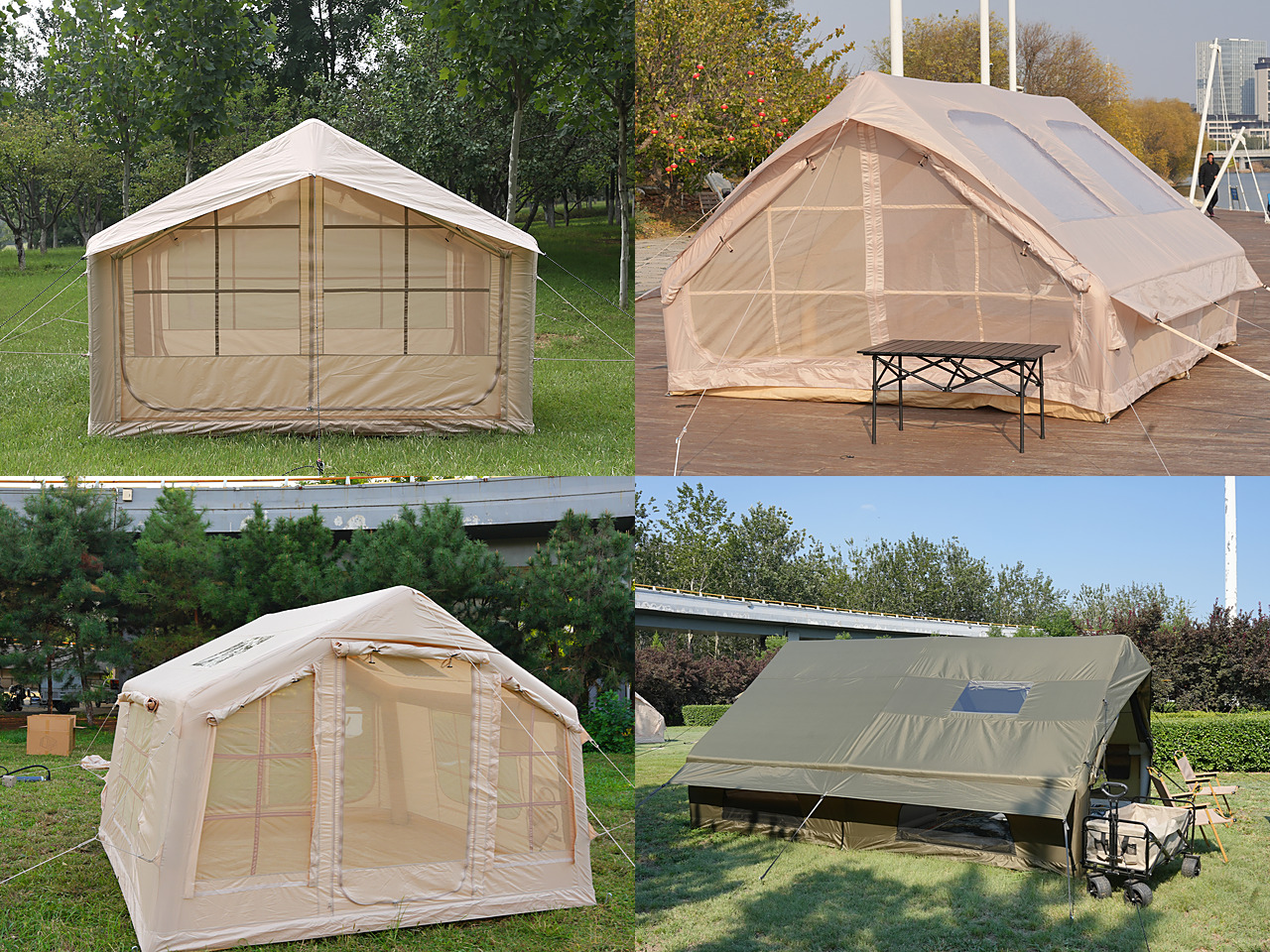
Adapting an existing construction is usually more predictable than redesigning a complete tent from the beginning. Compare available inflatable tent models by usable floor area, internal height, door position, ventilation, packed volume and intended application.
Capacity labels alone are not enough. Draw beds, luggage, furniture and walking space to scale. A compact unit may suit mobile retail or rental use, while a larger cabin tent may support longer family stays or furnished glamping. Our inflatable tent size guide explains how to compare floor area and real layouts.
When requesting a size modification, confirm whether the change affects beam geometry, fabric cutting, guy points, packaging, sample cost and inspection requirements. Even a small dimensional change can influence multiple connected components.
The inflatable frame must be treated as a complete structural system. For a model using PVC air columns, confirm the tube specification, welded construction, beam dimensions, valve type, protective sleeve, pump, adapter and service access. Do not select an operating pressure from another model or from a generic market claim.
Buyers should request:
the approved air-column layout and valve positions;
model-specific inflation and deflation instructions;
the compatible pump, gauge and adapter;
access to replaceable beams or service components where applicable;
an agreed pressure-retention inspection procedure;
spare valves, repair materials or replacement beams for commercial programs.
Read our detailed PVC air-column inspection guide before approving a sample. Color, logo and packaging cannot compensate for an inconsistent air-frame system.
“Oxford fabric” is a category, not a complete specification. Buyers should define the fabric construction, weight or denier where relevant, coating system, color, hand feel and required performance. The appropriate choice depends on transport, expected setup cycles, weather exposure, cleaning method and target price position.
Review the full material system:
outer tent fabric and coating;
groundsheet material and attachment method;
mesh specification and insect protection;
reinforcement at corners, doors, guy points and beam channels;
seam construction and any required sealing process;
zippers, webbing, buckles and other hardware.
Approve a physical color sample under suitable lighting. Screen colors and digital references can vary between devices. If color consistency is important for a brand program, define an approved standard, acceptable tolerance and the procedure for material substitutions.
Openings determine how the tent works after it is furnished. Before moving a door or adding a window, place beds, tables, luggage and storage areas on the floor plan. Make sure doors can open safely, mesh panels remain usable and furniture does not block ventilation.
Consider:
entry width and opening direction;
mesh doors and windows for insect control;
privacy curtains and internal operation;
roof or upper ventilation where supported by the model;
awning size, supporting poles and guyline clearance;
rain management around openings;
emergency access and any destination-market requirements.
Changing an opening may require new cutting patterns, reinforcement and sewing operations. Approve the completed sample rather than relying only on a drawing.
A private-label inflatable tent may use printing, a sewn label, a badge, an embroidered element or another application method, depending on the fabric, design and position. The factory should confirm what is technically suitable for the selected model.
Provide vector artwork when available and specify:
logo dimensions and exact placement;
approved colors and background;
orientation on every tent panel, bag and carton;
whether the mark must remain visible when doors or awnings are open;
care, abrasion and folding considerations;
label content required by the destination market.
Request an artwork proof before production and inspect branding on the complete sample. A logo can look correct on a flat file but become distorted by seams, curves, tension or folds on the finished tent.
A quotation is difficult to compare unless every included component is listed. Create a packing specification covering the tent body, PVC air columns, pump, gauge, adapter, pegs, guylines, awning poles, repair materials, instructions, storage bag and any optional equipment.
For distributors and commercial operators, spare parts should be discussed before the first order. Standardizing pumps, valves and repair components across several models can simplify training and inventory. Label model-specific beams clearly so that staff do not install the wrong length or valve position.
Packaging must protect the product and communicate clearly. Confirm the storage bag construction, carton strength, internal protection, gross and net weight information, carton dimensions, model code, barcode, shipping marks and handling labels.
The user manual should match the final OEM product—not a similar earlier model. It should show the component list, site preparation, inflation sequence, approved pressure, anchoring, ventilation, weather precautions, deflation, drying, storage, repair limits and contact route. Warnings and labels must be reviewed for the destination market by the buyer and qualified local advisers where required.
Before printing a full quantity, approve the manual and carton artwork as separate controlled files. Record the revision date so that outdated instructions are not packed with a changed product.
There is no single MOQ that applies to every custom air tent. The minimum order quantity can change with the base model, fabric availability, custom color, logo process, packaging, component sourcing and production schedule.
A change that uses existing materials and construction may be possible at a different quantity from a program requiring custom-dyed fabric, redesigned beams or fully printed retail packaging. Buyers should ask the supplier to separate the MOQ for each customization element rather than requesting one unexplained number.
| Request | Possible MOQ Influence | Question to Ask |
|---|---|---|
| Standard model and available color | Usually the simplest production route. | Which standard materials are currently available? |
| Custom logo only | Depends on the branding method and setup. | What artwork, size and application process are required? |
| Custom fabric color | May depend on material supplier minimums. | Can the color be matched from existing stock or must it be produced? |
| Structural or size change | May require patterns, sample development and new testing. | Which components and tooling are affected? |
| Private retail packaging | Printing suppliers may have their own minimums. | Can labels be customized separately from the carton? |
A photo is not enough for final approval. The pre-production sample should represent the materials, PVC air-frame, valves, dimensions, colors, logo, accessories and packaging agreed for bulk production.
Confirm the written brief. Resolve conflicting requirements before sample work begins.
Approve material and artwork references. Record codes, colors and file versions.
Inspect the sample dimensions and layout. Test it with the intended beds or furniture.
Pitch and pack repeatedly. Use the supplied pump, stakes, guylines and instructions.
Check the air system. Inspect inflation, beam alignment, valves, sleeves and retention according to the agreed procedure.
Review branding and packaging. Confirm every placement and printed detail.
Create a signed specification. Record all approved components and corrections before bulk production.
Keep the approved sample or a controlled reference sample for production comparison. Any later material or component change should be communicated and approved before use.
Lead time varies with order quantity, material procurement, custom color, logo method, sample revisions, packaging, factory schedule and season. A realistic schedule separates development from bulk production and shipping.
technical brief and quotation;
artwork and material confirmation;
sample production;
buyer testing and corrections;
pre-production approval;
bulk material preparation;
manufacturing and in-process inspection;
final inspection, packing and shipment booking.
Ask when lead time begins. It may start only after the deposit, artwork, sample and specification are approved. Buyers should also state the required arrival date rather than only the preferred shipment date, then allow time for freight, customs and local delivery.
OEM inspection must compare production with the approved specification, not with a general description. A practical plan should cover incoming materials, cutting, sewing, PVC air-column welding, valve installation, finished-tent inflation, dimensions, appearance, accessories and packaging.
Important checkpoints include:
model, color and material identification;
finished dimensions and symmetrical assembly;
PVC tube welds, valve position and sleeve fit;
inflation and retention test under defined conditions;
seams, reinforcement, zippers, mesh and groundsheet;
logo position, size, color and workmanship;
complete accessory count;
manual, labels, barcode and carton marks;
packing method and shipment quantity.
Use our 20-point inflatable tent quality-control checklist as a starting framework, then add the requirements specific to your OEM program.
Changing too many features before testing the standard model.
Approving colors only from a computer screen.
Sending a logo without dimensions, position or color references.
Comparing quotations with different accessories or packaging.
Assuming MOQ and lead time are the same for every customization.
Approving the tent but forgetting the manual, labels and carton.
Using an unapproved pressure or pump during sample evaluation.
Skipping repeated setup, cleaning and repacking tests.
Failing to secure spare valves, beams and repair materials.
Starting bulk production before a final specification is frozen.
Send the following information when requesting a quotation:
destination country and sales channel;
application: camping, rental, glamping, retail or project use;
preferred model, floor size and capacity;
required quantity and future order plan;
tent fabric, color and groundsheet preferences;
PVC air-column, valve, pump and spare-part requirements;
door, window, mesh and awning layout;
logo file, dimensions and placement;
accessory and packaging list;
testing, labeling and documentation requirements;
target delivery date and destination port or city.
A complete brief reduces assumptions and makes quotations easier to compare. It also helps the manufacturer identify customization requests that may affect sampling, MOQ, price or schedule. Buyers should still perform supplier qualification; our inflatable tent manufacturer selection guide provides a structured review process.
Logo customization may be available, depending on the fabric, position, artwork, application method and quantity. Confirm feasibility and approve a branded sample before bulk production.
MOQ depends on the base model and customization. Standard materials with a logo may have different requirements from custom colors, new dimensions or printed retail packaging. Request an itemized confirmation for your exact specification.
The schedule depends on material availability, sampling, revisions, order quantity, packaging and factory capacity. Confirm separate timelines for sample development and bulk production, and state the required arrival date.
Changes may be possible, but they can affect patterns, reinforcement, air-frame geometry and testing. Begin with a scaled layout and approve a complete functional sample.
Typical requirements may include brand, model, color, quantity, dimensions, weight, barcode, carton marks, instructions and destination-market labels. The buyer should confirm applicable local requirements.
Tianjin Tent Outdoor Products Co., Ltd. supplies inflatable camping and glamping tents for distributors, outdoor brands, rental operators and project buyers. OEM discussions can cover suitable base models, PVC air-column systems, colors, logos, openings, accessories and packaging according to production feasibility.
For a focused quotation, send your target market, application, preferred size, quantity, customization list and delivery destination to export@cntjtent.com. We will review the requirements and confirm the available options, MOQ and production schedule for the specific project.
Contact: Litai
Phone: 15613206703
E-mail: export@cntjtent.com
Whatsapp: +86 15613206703
Add: Tianjin Wuqing District entrepreneurial headquarters base c05