



export@cntjtent.com
+86 15613206703
A spacious beige inflatable tent beside a lake communicates a clear lifestyle promise: room to relax and a comfortable base for outdoor trips. For an importer or distributor, an appealing image is only the beginning. The commercial task is to translate that promise into a product range that dealers can explain, demonstrate, stock and support.
When sourcing inflatable tents wholesale, adding more sizes and colours does not automatically create a stronger offer. Each variant introduces another specification, stock decision and after-sales responsibility. A focused range gives each model a distinct role and makes the differences understandable to the sales team and the end customer.
Start with the intended customer rather than a list of available models. A specialist camping retailer, an online outdoor brand and a campsite equipment supplier may all sell tents, but they answer different questions. Retail customers may need a practical setup demonstration. Online customers need clear dimensions and an accurate packing list. Campsite buyers may place more emphasis on repeatable installation, cleaning access and replacement components.
Write a short brief for each channel: who buys, how the tent is transported, where it is used, what furniture is expected and who provides support. Avoid combining family camping, occasional events and long-term accommodation into a single product promise. Check each proposed use against the instructions and limitations of the specific model.
A useful assortment might include an introductory option, a core family-camping option and a larger comfort-oriented option. These are merchandising roles, not confirmed categories in a supplier catalogue. Choose the roles that fit your market, then match available products to them.
Differentiate models using information buyers can verify: usable floor dimensions, height distribution, entrance arrangement, packed size, weight and included accessories. Do not rely only on a nominal area or a person-count label. Ask whether the intended beds fit while leaving space for luggage and movement. Customers should understand the reason for choosing the next model without interpreting several nearly identical product pages.
Request the same information for every shortlisted inflatable tent. Record the fabric description, floor construction, air-column specification, valve arrangement, inflation instructions, window configuration and accessory list. Keep optional equipment separate from the standard package. A photographed chair, storage box or decorative lantern should not become an assumed inclusion.
Use three evidence categories in your working sheet: confirmed by the supplier, verified on the sample, and awaiting confirmation. This prevents an early discussion from becoming an unsupported catalogue claim. Broad phrases such as weatherproof or quick setup need model-specific evidence and clearly stated conditions.
A sample should help the sales team learn the full ownership experience. Unpack the tent, identify every component, follow the supplied inflation sequence, complete the anchoring process and repack it. Record the number of people involved and the complete task time. Pumping time alone is not the same as a customer-ready setup.
Check the questions that arise during the demonstration. Are valve connections easy to identify? Can staff explain the recommended pressure procedure? Are doors and windows straightforward to operate? Can the tent be packed into its bag using the stated method? Turn the answers into a concise dealer guide, supported by photos of the supplied version.
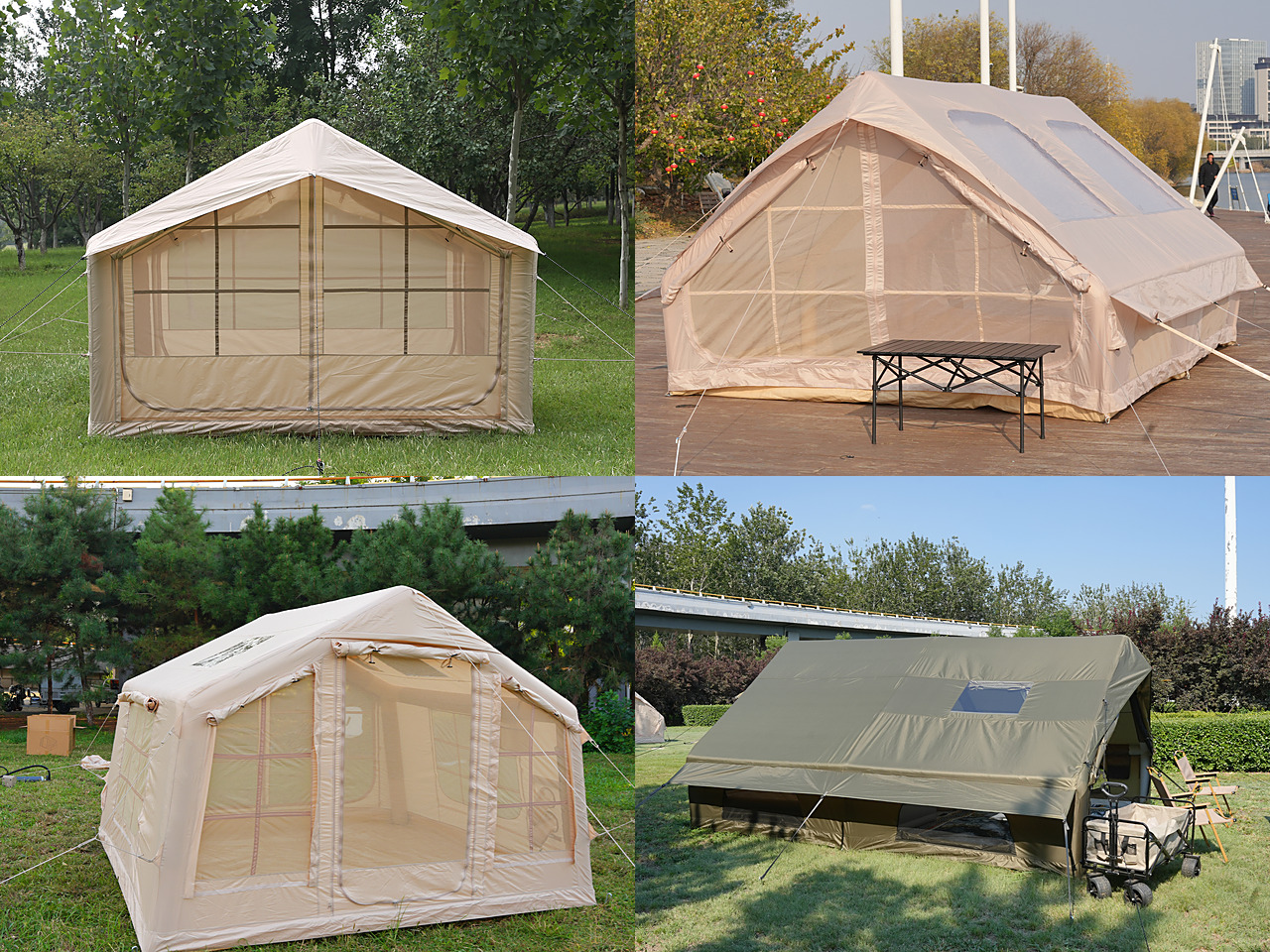
The beige-tent image offers a visual starting point for a comfort-oriented range. Before using it as a product specification, confirm which model and configuration it represents. Promotional styling does not establish dimensions, performance ratings or the contents of the carton.
Create a consistent asset pack for each SKU: exterior views, interior layout, dimensional drawing, packing list and setup instructions. Label optional configurations clearly. If branding or packaging changes are requested, agree the artwork and availability before advertising them. Dealers need accurate material to answer questions without borrowing specifications from another model.
For a new range, separate demonstration stock from saleable stock and any agreed service reserve. Decide how you will measure demand before expanding the assortment. Track enquiries by model, reasons customers decline a purchase, accessory questions and support workload after delivery.
A limited pilot can reveal whether customers need a different layout, clearer instructions or a different package. These findings are more useful than assuming every colour and size will sell equally. Discuss reorder quantities, packaging and lead times with the supplier, and tie customer delivery promises to confirmed arrangements.
Ask how a dealer should identify a replacement component and what information is needed for a support request. Model identification, production details, photographs and a clear description of the issue can make communication more efficient. Confirm which repairs are suitable for local handling and which require supplier guidance.
Do not assume that visually similar air columns, valves or repair materials are interchangeable. Maintain a version-controlled specification and accessory list for each SKU. When a product changes, update the dealer documents and purchasing record so earlier customers receive instructions for their version.
One clearly defined customer and use case for each product tier.
Comparable dimensions, package contents and material descriptions.
A completed setup and repacking demonstration for the sample.
Product images and written claims matched to the supplied version.
An initial order plan separating samples and saleable inventory.
A documented route for spare-part identification and support.
Select models with distinct customer roles and expand using enquiry and sales information. The appropriate range depends on your channel and service capacity.
Use it to communicate the intended setting, then confirm dimensions, construction, accessories and performance separately for the quoted model.
Include the destination market, sales channel, intended use, target product tiers, approximate order quantity and required launch timing. These details make the discussion more specific than a request for the lowest price.
For a B2B discussion with LITAI ANTOUR, email info@litaishoes.com. Share your customer profile and range requirements to request information on available models, specifications and quotation options.
Contact: Litai
Phone: 15613206703
E-mail: export@cntjtent.com
Whatsapp: +86 15613206703
Add: Tianjin Wuqing District entrepreneurial headquarters base c05