



export@cntjtent.com
+86 15613206703
Tent fabric is not a minor specification. For an importer, distributor, campsite operator or private-label brand, it directly influences product weight, packing volume, durability, indoor comfort, maintenance requirements and the final retail position. Three materials frequently discussed in the tent market are 210D Oxford, 420D Oxford and TC cotton canvas. They can all produce a good tent, but they are designed for different priorities.
The short answer is that 210D Oxford is usually selected when low weight, compact packing and price control matter most; 420D Oxford offers a stronger balance for family inflatable tents, car camping and repeated commercial use; and TC cotton canvas is preferred when breathability, a quieter interior and a premium glamping experience are more important than low transport weight.
However, the material name alone is not enough to approve a purchase order. Denier, fiber composition, weave density, coating, hydrostatic-head performance, seam construction and finishing standards must be evaluated together. This guide explains how professional buyers can make that decision.
Buyer’s key takeaway
A higher denier normally indicates a heavier yarn, but it does not automatically guarantee a stronger or more waterproof finished tent. Ask for the complete fabric specification and relevant test results, not only “210D” or “420D” on a quotation.
| Evaluation Point | 210D Oxford | 420D Oxford | TC Cotton Canvas |
|---|---|---|---|
| Typical buyer priority | Lower weight and compact packing | Balanced durability and transportability | Comfort and premium positioning |
| Relative weight | Light | Medium | Heavy |
| Breathability | Low when coated | Low when coated | High compared with coated synthetics |
| Packing volume | Small | Moderate | Large |
| Drying speed | Fast | Fast | Slower; must be fully dried before storage |
| Commercial use | Entry-level retail, short trips, weight-sensitive designs | Family air tents, rental fleets, car camping, repeated setup | Glamping, long-stay camps, premium accommodation |
| Price position | Economical | Mid-range | Premium |
Note: These are general market tendencies. Finished performance varies with yarn quality, fabric construction, coating, treatment and tent design.
“D” stands for denier, a unit of yarn linear density. One denier represents one gram per 9,000 meters of yarn. Therefore, a 420D yarn has a greater linear mass than a 210D yarn of the same general fiber type. In comparable constructions, the higher-denier fabric often feels heavier and more substantial.
Denier is not the same as fabric weight in grams per square meter, and it is not a direct measurement of tensile strength, tear strength or waterproofness. Two suppliers can both quote “420D Oxford” while delivering fabrics with different thread counts, coating weights, weave quality and test performance.
It is also important to understand that Oxford describes a basket-style woven construction, not a complete material specification. Commercial tent Oxford is often polyester, but nylon Oxford also exists. A professional quotation should state the fiber composition, denier, finished GSM, coating system and waterproof rating.
210D Oxford is commonly used when the product must remain relatively light, easy to fold and economical to ship. It can be suitable for compact camping tents, inner sections, accessory bags, temporary shelters and retail products designed for occasional recreational use.
Its lower mass can reduce packed size and freight cost, which is valuable for e-commerce programs and markets where consumers carry the tent over longer distances. A well-made 210D polyester Oxford with an appropriate PU coating and properly sealed seams can provide dependable rain protection for its intended use.
The trade-off is a smaller margin against abrasion, repeated folding and rough handling compared with a heavier fabric of similar construction. This does not make 210D “poor quality”; it means the specification should match the product’s duty cycle. A lightweight weekend tent and a rental tent pitched dozens of times per season should not automatically use the same shell fabric.
Low packed weight is a major selling point.
The tent is intended for recreational or occasional use.
The distributor needs an accessible entry-level price.
Small carton dimensions help control warehouse and courier costs.
The design does not expose the fabric to frequent commercial handling.
420D Oxford is often selected for larger family tents and inflatable tents because it provides a useful balance between fabric body, durability, packability and price. Compared on a like-for-like basis with 210D, it generally uses a heavier yarn and can offer better resistance to repeated handling and abrasion. The finished tent remains far easier to transport and dry than many heavy canvas constructions.
This balance is especially relevant to car-camping products, family air tents, rental fleets and distributor programs that need a robust product without moving into the weight and cost class of TC canvas. It also gives the shell a more substantial hand feel, which can support a higher retail position.
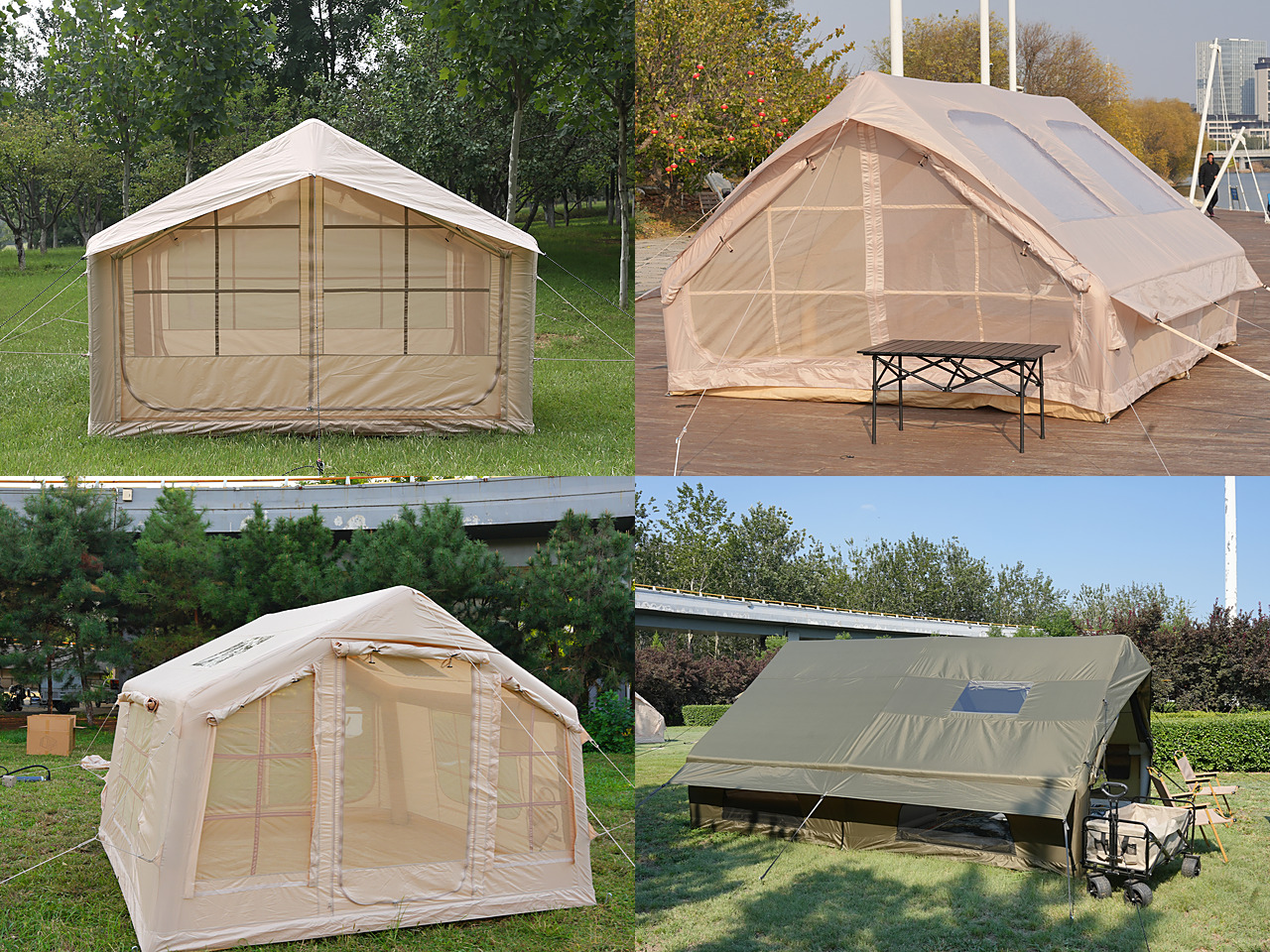
For example, the AT-12X inflatable tent uses 420D Oxford in a 300 × 400 × 220 cm layout. The material choice suits a spacious 3–6 person air tent with a pole-supported awning because buyers typically expect repeated pitching, family use and a durable outer shell while still requiring practical transport and storage.
Buyers should still request the complete specification. A nominal 420D fabric with a weak coating or inconsistent weaving can perform worse than a carefully engineered lighter fabric. Confirm hydrostatic-head performance, tear strength, colorfastness, coating adhesion and seam compatibility on the finished material.
The tent is designed for family camping or drive-up campsites.
Users value durability more than minimum pack weight.
The product will be pitched and packed repeatedly.
The importer wants a mid-range or premium synthetic tent.
Quick drying and straightforward maintenance are important.
TC generally means a polyester-cotton or “technical cotton” blend. The exact ratio is not universal: 65% polyester/35% cotton, 35% polyester/65% cotton and other blends are all found in the market. The supplier must declare the actual composition and finished fabric weight.
Cotton fibers allow moisture vapor to pass through more readily than a fully coated synthetic shell. This can reduce condensation and create a more stable, comfortable interior during warm days and cool nights. TC canvas is also usually quieter in wind and has a natural appearance that fits glamping resorts, safari-style accommodation and premium camping brands.
Water resistance is normally achieved through dense weaving and a water-repellent treatment. When cotton fibers become wet, they swell and help close small gaps in the weave. Some TC tents benefit from an initial weathering process, depending on the fabric system and manufacturer’s instructions.
The disadvantages are operational. TC canvas is heavier, bulkier and slower to dry. It should never be packed away damp for long periods because moisture can lead to odor, staining or mildew. Campsites and rental operators therefore need suitable drying space, trained staff and a realistic maintenance plan. Freight cost and carton volume must also be considered at the quotation stage.
Guest comfort and indoor climate are major selling points.
The tent is used for glamping or longer stays.
A natural, premium appearance supports the brand concept.
Transport weight is less important than on-site experience.
The operator can dry, clean and maintain the tent correctly.
A frequent purchasing mistake is assuming that denier determines waterproofness. It does not. For coated Oxford fabric, rain resistance depends heavily on the PU, PVC or other coating system, coating consistency, hydrostatic-head performance and seam sealing. For TC canvas, it depends on weave density, impregnation, stitching and correct weathering or maintenance.
A buyer should ask whether the quoted waterproof value applies to new fabric only or whether performance has also been evaluated after aging, flexing or washing. Seam construction is equally important. Water can enter through needle holes, zipper areas, poorly covered roof joints or stress points even when the base cloth has a high laboratory rating.
The correct question is not “Which fabric is waterproof?” but “Does the complete tent construction meet the rain-performance requirement for the intended market and service life?”
Finished weight: Request GSM in addition to denier. Finished weight includes the base cloth and coatings and is more useful for estimating pack weight.
Tear and tensile strength: Ask for test methods and actual results. These properties matter around guy points, zippers, corners and repeated folding lines.
Water resistance: Review hydrostatic-head targets, coating type, seam tape or seam-sealing method and finished-tent rain testing.
UV and color performance: Long exposure can weaken textile fibers and fade dark colors. Products for sunny campsites require an appropriate UV and colorfastness plan.
Condensation management: TC fabric offers natural breathability, while synthetic tents rely more heavily on vents, mesh openings, double-wall construction and user ventilation.
Maintenance: Oxford fabrics usually dry faster and are easier for rental teams to turn around. TC canvas requires thorough drying and periodic care.
Compliance: Fire-retardancy requirements differ by destination and application. Do not assume that a fabric is flame retardant unless the treatment and relevant test report are specified.
| Business Model | Recommended Starting Point | Reason |
|---|---|---|
| Entry-level outdoor retail | 210D Oxford | Controls weight, package size and price. |
| Family inflatable tent range | 420D Oxford | Balanced durability, practical drying and marketable quality. |
| Rental fleet | 420D Oxford | Better suited to repeated pitching and handling than a light-duty specification. |
| Glamping resort | TC cotton canvas | Comfort, appearance and reduced condensation support a premium guest experience. |
| Weight-sensitive camping product | 210D Oxford | Lower shell weight and more compact packing. |
| Long-stay premium camping | TC cotton canvas | Comfort and natural aesthetics can justify higher logistics and maintenance costs. |
Before confirming a sample or bulk order, include the following points in the request for quotation:
Fiber composition: polyester, nylon or exact polyester/cotton ratio.
Yarn specification: 210D, 420D or the applicable yarn count.
Finished fabric weight in GSM and acceptable tolerance.
Weave structure, thread density and ripstop requirement if applicable.
Coating material, coating side and coating weight.
Required hydrostatic-head value and test method.
Tear strength, tensile strength and abrasion expectations.
UV resistance, colorfastness and target climate.
Seam tape, seam sealing and finished-tent rain-test procedure.
Flame-retardancy requirement for the destination market.
Fabric color, color tolerance, logo method and minimum order quantity.
Packaging size, finished tent weight and spare material requirements.
This checklist makes quotations easier to compare. Without it, two prices labeled “420D Oxford” may represent very different products.
Mistake 1: Choosing the highest denier automatically. Extra material can increase shipping weight and packed volume without improving the customer’s experience enough to justify the cost.
Mistake 2: Comparing denier but ignoring GSM and coating. The finished fabric, not the yarn number alone, determines the practical result.
Mistake 3: Treating TC as maintenance-free. Breathability and comfort come with stricter drying and storage requirements.
Mistake 4: Approving only a fabric swatch. Test a complete tent. Seams, zippers, windows, guy points and roof geometry all influence performance.
Mistake 5: Using one specification for every market. A weekend retail tent, a European family air tent and a permanent glamping installation have different priorities.
No. The denier value describes yarn linear density, not finished-fabric strength. Fiber quality, weave, thread density, coating and finishing also affect performance. Compare laboratory results on equivalent test methods.
No fabric should be approved from the name alone. Waterproof performance depends on the coating system, hydrostatic-head value, seam sealing and complete tent construction.
TC is more breathable than fully coated synthetic Oxford and can help create a more comfortable indoor climate. Ventilation and campsite conditions still affect condensation.
For many rental fleets, 420D Oxford is a practical starting point because it balances repeated handling with faster drying and simpler storage. The final choice should reflect climate, setup frequency and staff procedures.
TC cotton canvas is attractive for premium glamping because of its breathable interior and natural appearance. A coated synthetic fabric may be preferable where frequent relocation, rapid drying or lower freight cost is more important.
The tent shell and the inflatable structure are separate systems. Inflatable beams normally use an airtight inner tube with a protective sleeve. Buyers should evaluate the air-tube material, weld quality, valve system and sleeve construction separately from the flysheet specification.
There is no single “best” tent fabric for every customer. Choose 210D Oxford for weight-sensitive and cost-conscious products, 420D Oxford for a durable and transportable family or commercial air-tent program, and TC cotton canvas for premium comfort-led glamping applications.
The safest purchasing decision is based on the complete material specification, test requirements and actual usage scenario. Tianjin Tent Outdoor Products Co., Ltd. can help importers, distributors and campsite operators evaluate tent size, fabric, air-beam structure, accessories, branding and packaging as one integrated product.
Planning an inflatable tent or private-label camping project?
Send your target market, expected order quantity, preferred size and performance requirements to export@cntjtent.com. We will recommend an appropriate material specification for sampling and quotation.
Contact: Litai
Phone: 15613206703
E-mail: export@cntjtent.com
Whatsapp: +86 15613206703
Add: Tianjin Wuqing District entrepreneurial headquarters base c05