



export@cntjtent.com
+86 15613206703
Choosing between an inflatable tent and a traditional pole tent is not only a product decision. For a glamping site or rental fleet, it affects labor planning, staff training, transport, repair procedures, spare-parts inventory, guest experience and total operating cost. The better choice depends on how often the tent moves, who pitches it, how quickly it must return to service and what experience the customer expects.
In general, inflatable tents are attractive when fast, repeatable setup and simplified training have high value. Pole tents remain competitive when low purchase price, compact component replacement or traditional lightweight construction is the priority. Neither frame system guarantees weather performance by itself; fabric, geometry, anchoring and manufacturing quality remain essential.
Decision in one sentence
Choose an air tent when labor efficiency and a straightforward customer setup are worth the added air-system service requirements. Choose a pole tent when entry cost, weight or easy replacement of conventional frame parts matters more than setup speed.
| Business Factor | Inflatable Tent | Pole Tent |
|---|---|---|
| Setup process | Inflate beams, then peg and tension; fewer long frame pieces to assemble. | Identify, assemble and insert poles before final pegging and tensioning. |
| Training consistency | Often easier to standardize with a pressure guide and pitching sequence. | Depends more on correct pole matching, routing and sleeve handling. |
| Typical pack character | Can be heavier or bulkier because beams, sleeves and pump stay with the tent. | Frame components may pack separately; lightweight designs can be easier to carry. |
| Field repair | Tube, valve, hose or seal diagnosis; replacement parts must match the system. | Bent, cracked or broken pole sections can often be identified individually. |
| Setup equipment | Compatible pump with an accurate gauge. | Usually no pump, but pole sets and connectors must remain complete. |
| Customer perception | Modern, convenient and suitable for large family layouts. | Familiar, traditional and available across broad price levels. |
| Best-fit commercial priority | Fast turnover, simplified setup and premium family camping. | Price control, lower carry weight or familiar maintenance. |
These are general tendencies. Always compare complete models of similar size, fabric, capacity and weather specification.
A common purchasing mistake is comparing a large family air tent with a smaller entry-level pole tent and then attributing every difference to the frame. Floor area, wall height, fabric, groundsheet, windows, awning size and accessories can change weight and price more than the frame type.
For a meaningful evaluation, compare tents with similar usable floor area, standing height, occupancy, fabric specification, waterproof target, number of doors and included accessories. Record the complete packed weight and carton size, including pump, pole bag, pegs and repair kit.
The same principle applies to glamping. A breathable TC canvas tent and a coated polyester tent deliver different indoor environments regardless of whether they use air beams or poles. Our tent fabric comparison guide explains how material choice affects comfort, weight and maintenance.
Setup is where inflatable tents often create the clearest operational advantage. Instead of assembling and feeding several long poles through sleeves, staff connect a pump, raise the beam structure, then complete pegging and guyline tensioning. The process can be easier to teach and repeat, especially on large family models.
This does not mean that an air tent is automatic. The team still needs to orient the tent, close deflation valves, use the correct adapter, inflate to the specified pressure and anchor the structure accurately. A poor pitch cannot be corrected simply by adding more pressure. See our guide to inflatable tent valves, air beams and pressure systems for the technical procedure.
Pole tents require a different workflow. Staff must match pole sections, assemble them without damaging joints, route them through the correct sleeves and apply bending loads in the intended direction. Experienced teams can work efficiently, but training errors may include crossed poles, skipped clips, damaged sleeves or incomplete pole sets.
Buyers should not rely on a promotional “pitching time.” Run a controlled trial using the people who will actually operate the product. Record labor minutes from opening the bag to the final safety check, then repeat the test after several cycles. Consistency is often more important than the fastest single demonstration.
Air tents keep the inflatable frame with the body and require a pump. This simplifies part counting but may create a larger or heavier package. Pole tents can divide the load between a fabric bag and a pole bag, which may help manual handling and vehicle packing.
For a fixed glamping site, pack weight may matter only during installation and seasonal storage. For a rental business delivering tents to events every week, carton dimensions, vehicle capacity and handling ergonomics become daily cost factors. An extra kilogram on one tent can become a significant fleet burden.
Storage procedures also differ. Both systems must be completely dry before long-term storage. Air systems need protection for valves, hoses and bladders, while pole systems need organized sets and protection against bending, corrosion or loss of individual sections. Label every bag with the model and a complete component checklist.
The relevant question for commercial buyers is not “Can this tent be damaged?” Every tent can. The useful question is “How quickly can our team identify the fault, obtain the correct part and return the unit to service?”
Airtight inner tube, welded seams and patchable punctures.
Inflation and deflation valves, caps and seals.
Connecting hoses or isolation valves in single-point systems.
Protective sleeves, access zippers and beam alignment.
Pump, pressure gauge, hose and adapters.
A well-designed air beam can be replaced without discarding the complete tent, but the spare must match length, diameter and valve position. Commercial buyers should secure spare tubes and valve parts with the original order.
Cracked fiberglass sections or bent metal poles.
Damaged ferrules, elastic cord and pole joints.
Torn pole sleeves or worn clips.
Missing color-coded sections or mixed model components.
Corrosion after wet or coastal use.
Pole repairs may be familiar and individual sections can be economical, but a missing or incorrectly matched section can still stop the complete tent from being used. Standardization across a fleet is valuable for both frame systems.
In glamping, the frame is mostly invisible to the guest, but it influences the shape and daily operation of the accommodation. Pre-shaped air beams can create generous standing height and reduce rigid interior obstructions. Large windows, ventilation, doors, awnings and fabric choice then determine how spacious and comfortable the tent feels.
Pole tents can achieve equally attractive layouts and may suit customers who value traditional canvas architecture. Steel or aluminum poles can produce clear, defined forms. The final experience depends more on layout, fabric, furniture clearance, ventilation and weather protection than on the frame label.
For consumer rentals, convenience becomes part of the product. A first-time renter may feel more confident following a pressure gauge than assembling many poles. However, the rental company must provide clear instructions and a reliable pump. A missing adapter can be as disruptive as a missing pole section.
Air beams flex under load and can recover their shape, while pole frames provide defined mechanical rigidity. Neither behavior is automatically superior in every storm. Stability depends on tent geometry, frame spacing, fabric cut, reinforcements, correct pressure or pole assembly, peg holding power and guyline placement.
Campsites should create operating limits based on the tested product and local conditions. Staff need a weather plan that covers inspections, guyline adjustment, guest communication and when to take a unit out of service. Do not use unverified wind claims or assume that a larger beam or thicker pole guarantees a complete-tent rating.
ISO 5912:2020 specifies requirements and test methods relating to the safety, performance and fitness for use of camping tents. Buyers should also confirm fire, labeling and campsite requirements in the destination market, particularly for paid accommodation or public events.
A lower unit price does not always create a lower operating cost. A practical commercial comparison can use the following structure:
Lifecycle cost = purchase price + inbound freight + setup labor + cleaning and drying + repair parts + downtime + replacement cost
For example, an inflatable model may cost more initially but save labor across repeated rental cycles. A pole tent may be less expensive and easier to split into transport bags, but require more training or assembly time. The answer depends on actual wages, fleet utilization, travel distances and service capability.
Include the value of downtime. If one unavailable tube, valve or pole section prevents a popular tent from being rented during peak season, the lost revenue can exceed the price difference between the two systems.
| Scenario | Recommended Starting Point | Reason to Evaluate |
|---|---|---|
| High-turnover family rental fleet | Inflatable tent | Repeatable pitching and fewer long frame parts can reduce training time. |
| Remote rental with limited pump support | Pole tent | No pressure equipment is required, provided the pole set remains complete. |
| Premium glamping accommodation | Compare both | Fabric, layout and guest comfort may matter more than frame type. |
| Mobile event setup by a small crew | Inflatable tent | Labor efficiency may justify higher initial cost and service inventory. |
| Price-sensitive retail program | Pole tent | Broad range of economical structures and familiar consumer positioning. |
| Large family car-camping range | Inflatable tent | Fast setup and spacious pre-shaped beams support a premium offer. |
| Backpacking or frequent manual carrying | Pole tent | Lightweight pole systems generally fit weight-sensitive applications better. |
For a commercial project, test samples under the same procedures planned for daily operation. Use more than one staff member and repeat setup, pack-down, cleaning and storage. A useful pilot records:
Total labor minutes for setup and pack-down.
Number of people required at each stage.
Training errors and steps that need clearer instructions.
Vehicle and storage space per complete unit.
Drying time after rain or cleaning.
Parts most likely to be lost, damaged or incorrectly fitted.
Guest feedback on space, ventilation, noise and accessibility.
Repair time and availability of model-specific spares.
A pilot converts general product claims into data relevant to your own business. It also reveals whether packaging, manuals and spare-parts labeling are suitable before the order becomes large.
Compare equivalent floor area, height, capacity and fabric specification.
Request complete packed weight and carton dimensions.
Review setup instructions and perform repeated sample pitches.
For air tents, approve pressure, valves, pump, gauge and replacement tubes.
For pole tents, approve pole material, diameter, wall thickness, joints and repair sections.
Inspect reinforcement at beam channels, pole sleeves, guy points and floor corners.
Define finished-tent rain and quality-control requirements.
Confirm destination-market safety, labeling and fire requirements.
Agree spare-parts quantities and warranty responsibilities before shipment.
Calculate freight, labor, repair and downtime across the expected service period.
They often reduce frame assembly and can be faster for large family layouts, but final time still includes positioning, inflation, pegging and guyline tensioning. Verify with a repeated trial using your staff.
Durability depends on the complete design and use. Air beams avoid bent or snapped rigid poles, while valves and tubes require their own maintenance. Compare failure modes and repairability rather than relying on a general claim.
Either can work. For a fixed site, guest comfort, fabric, layout, ventilation and maintenance may be more important than setup speed. Air tents become especially attractive when units are moved or reset frequently.
It depends on part availability and labor. A pole section may be inexpensive, while a replaceable inner tube can also restore an air tent without replacing the shell. Confirm spare pricing before purchase.
Manual high-pressure pumps are available, so electricity is not inherently required. Electric pumps can improve fleet efficiency but need controlled pressure and an appropriate power plan.
Frame type alone does not determine wind performance. Use tested model data and correct pitching, pressure or pole assembly, pegs and guylines. Site exposure and ground conditions also matter.
For rental fleets with frequent turnover, large family layouts and a small setup team, an inflatable tent is often the stronger operational starting point. For weight-sensitive products, price-led retail or locations where pumps and model-specific air parts are difficult to support, a pole tent may be more practical. Glamping operators should compare both systems at the complete-product level and prioritize guest comfort, maintenance and lifecycle cost.
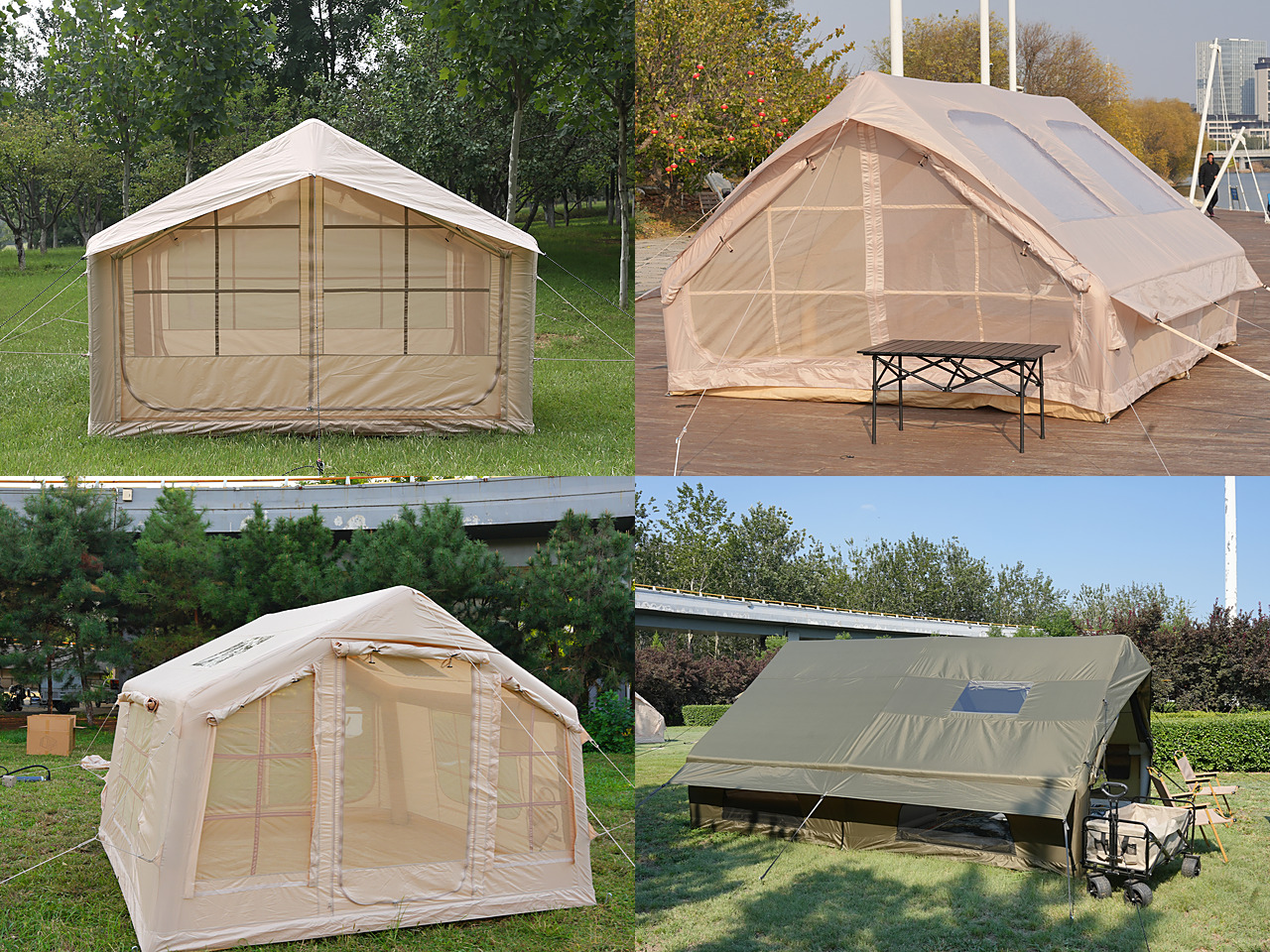
The AT-12X is one example of a spacious 3–6 person inflatable tent designed with 15 cm air beams and a pole-supported awning. It illustrates how air and rigid support elements can be combined when the design requires both fast setup and an extended covered area.
Planning a glamping site or commercial rental fleet?
Send your intended use, target capacity, climate, order quantity and preferred fabric to export@cntjtent.com. Tianjin Tent Outdoor Products Co., Ltd. can help compare inflatable and pole-supported solutions for your project.
Contact: Litai
Phone: 15613206703
E-mail: export@cntjtent.com
Whatsapp: +86 15613206703
Add: Tianjin Wuqing District entrepreneurial headquarters base c05